
Supported living tenders scored on outcomes, not intentions
Commissioners want to see how you deliver person-centred support, not that you have a policy about it. We write responses that prove capability with specific evidence, named processes, and measurable outcomes.
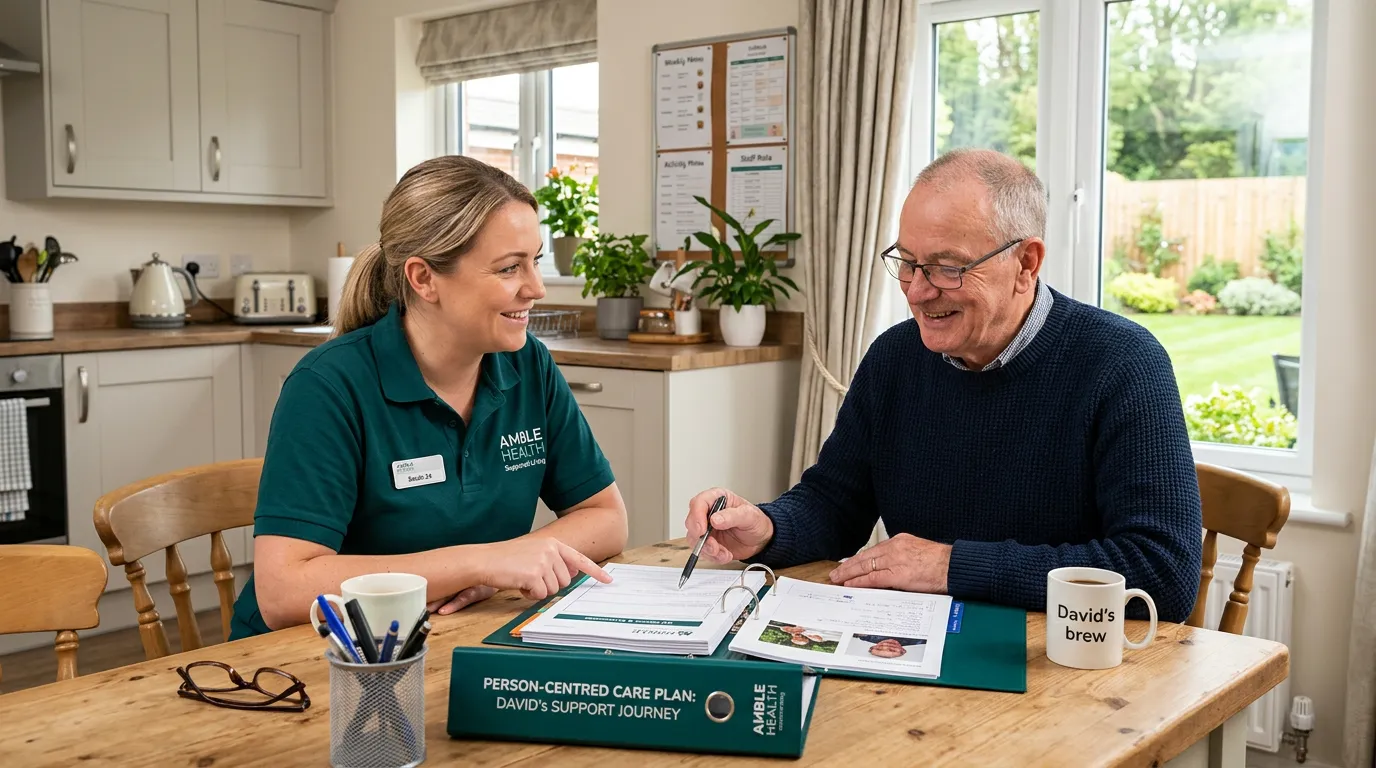
The supported living tender landscape
Supported living is one of the most actively procured care services in England. Local authorities and NHS commissioners regularly tender for providers through frameworks, DPS routes, and open competitions. Contract values range from spot purchases for individual placements through to multi-million pound frameworks covering entire regions.
The shift toward supported living and away from residential care has been a consistent policy direction for over a decade. More people with learning disabilities, autism, mental health conditions, and physical disabilities are being supported to live in their own homes or shared accommodation rather than in registered care homes. That policy direction means more commissioning activity, more tenders, and more competition for the contracts that come to market.
Most supported living contracts are awarded through frameworks or Dynamic Purchasing Systems rather than one-off tenders. The framework application is the gateway. Miss it, and you’re locked out of every call-off for 2–4 years. If a framework window is open now, that is the priority.
Named procurement routes
Knowing which route a contract is coming through changes how you position the bid. The main procurement vehicles in supported living:
- Regional DPS registers — many local authorities now run open Dynamic Purchasing Systems for supported living, where providers can join at any point but are called off through mini-competitions. Terms are typically 4+2 years with call-off competitions scored on quality and price.
- NEPO frameworks — the North East Procurement Organisation runs aggregated supported living frameworks on behalf of member councils. Successful applications cover the whole North East region; a weak application locks you out entirely.
- NHS Continuing Healthcare (CHC) — where a service user’s primary need is health-related, NHS England funds the placement through CHC. CHC-commissioned contracts carry additional clinical governance expectations and NHS contract terms rather than local authority standard terms.
- Section 117 aftercare — people leaving detention under the Mental Health Act are entitled to aftercare under Section 117, jointly funded by the ICB and local authority. These contracts involve dual commissioners from the outset, which affects how you evidence multi-agency working in the tender.
- Transforming Care programme — NHS-led procurement specifically for people moving from Assessment and Treatment Units (ATUs) into community settings. Higher complexity of need, stronger emphasis on positive behaviour support evidence, and frequently involves NHS England regional teams as commissioners rather than local ICBs.
Understanding the route tells you who is scoring, what their institutional priorities are, and what contract conditions you will be agreeing to before you write a single word.
The five areas where supported living tenders are won or lost
Every buyer’s criteria are different, but across hundreds of supported living tenders, the same themes come up. Here’s what gets scored and what makes the difference between 3/5 and 5/5.
1. Person-centred outcomes
This is usually the highest-weighted section. Commissioners don’t want to know that you “put the person at the centre of everything you do.” They want to see your assessment process, how you develop support plans, how you measure progress, and what happens when outcomes aren’t being achieved.
“We deliver person-centred support tailored to individual needs.”
Describes your assessment framework by name, explains the review cycle (how often, who’s involved, what triggers an unscheduled review), shows outcome measurement tools you actually use, and provides data: “78% of people we support achieved at least one personal goal in the last 12 months.”
2. Safeguarding
Every tender asks about safeguarding. Most providers give the same answer: “All staff complete safeguarding training.” That scores 2/5.
“All staff complete safeguarding training.”
Shows the system: what level of training (and for which roles), how incidents are reported (timescale, to whom, through what system), how learning from incidents changes practice (with a real example), what oversight exists at management and board level, and your track record — e.g. zero CQC safeguarding escalations in X months.
3. Workforce
Recruitment, retention, training, supervision, and competency. Adult social care is carrying approximately 152,000 vacancies in England (Skills for Care, 2024/25), with supported living turnover running at around 28–30% annually. Evaluators know this. They want to see how you attract and keep good people — not reassurance that you try to.
“We recruit high-quality staff and provide ongoing training.”
Your staff retention rate versus the sector average, your recruitment process and timeline, supervision frequency and format, mandatory and specialist training programmes, and how you manage workforce gaps without disrupting service. If your retention rate outperforms the sector average, that number belongs in the first sentence.
4. Quality governance
How you monitor, audit, and improve service quality. Not “we have a quality assurance framework.” What’s in it? Who runs the audits? How often? What KPIs do you track? What happens when KPIs aren’t met? Show the loop: monitor, identify, act, evidence improvement.
Commissioners have seen enough failed services to be sceptical of quality claims without evidence. CQC reports are checked. If your most recent inspection raised concerns about governance and your tender response says governance is excellent, that’s a credibility problem.
5. Mobilisation and TUPE
How you transition from contract award to live service delivery. For existing services with staff transferring under TUPE, this gets detailed scrutiny. Buyers want a week-by-week plan: due diligence, staff consultation, service user engagement, IT and systems setup, risk management.
If you’ve never managed a TUPE transfer, that doesn’t automatically disqualify you — but you need to show you understand the obligations, have a realistic plan, and have sought appropriate legal and HR advice.
What makes supported living procurement different from other care sectors
Supported living tenders are not interchangeable with domiciliary care or residential care tenders. The evaluation priorities, funding structures, and commissioner concerns are distinct.
Outcome-based commissioning, not activity-based. Domiciliary care contracts are typically priced and monitored by hours delivered. Supported living contracts increasingly use outcome-based models: commissioners want to see independence goals, reduced reliance on support hours over time, and measurable progress against individual outcomes. Tender responses that describe what your staff do (hours, visits, tasks) rather than what changes for the people you support will score below providers who can evidence outcomes.
Higher safeguarding weighting. Supported living commissioners apply greater scrutiny to safeguarding than most other care sectors because the population includes people with complex needs, limited capacity to raise concerns themselves, and histories of institutional abuse. Weighting of 20–30% on safeguarding questions is common. A response that describes policy but cannot show application and learning will be scored poorly even by lenient evaluators.
Complex needs requiring multi-disciplinary evidence. Contracts covering people with learning disabilities, autism, acquired brain injury, or complex mental health needs require you to demonstrate competency across clinical, behavioural, and social dimensions. Evaluators look for evidence of multi-agency working — how you engage with community learning disability teams, positive behaviour support specialists, speech and language therapists, and the people commissioning CHC placements alongside the local authority.
Dual-commissioner scenarios. Where a service user has both health and social care needs, funding may be split between an ICB and a local authority under Section 117 or CHC rules. Tenders for these services require you to demonstrate how you manage different governance requirements, reporting lines, and contract conditions from two commissioners simultaneously.
What commissioners in this sector are actually worried about
Understanding what keeps a commissioner up at night is the most direct route to a high-scoring bid. The concerns that drive scoring decisions in supported living:
- Provider failure and continuity. Commissioners have been badly burned by providers going into administration mid-contract. They are looking for financial stability evidence, contingency arrangements, and clear escalation plans. If you have been trading for under three years, expect this to be probed.
- CQC registration delays. New services cannot operate until CQC registration is complete. Evaluators score your mobilisation plan partly on whether you have a realistic timeline for registration and what contingency exists if it is delayed.
- Void management. Commissioners funding shared accommodation settings hate paying for empty beds while a service is being mobilised or when a service user moves on. A strong tender addresses your approach to rapid occupancy, step-down capacity, and what happens between placements.
- Outcomes measurement. The shift from outputs to outcomes is real and ongoing. Commissioners are being held accountable for whether the people they commission for are achieving independence goals, not just receiving hours. Providers who can demonstrate their outcomes measurement methodology — and back it with data — are increasingly preferred over those who cannot.
Where we see marks being left on the table
- Talking about values instead of methods. “We believe in promoting independence” scores nothing. “Our independence pathway has three stages: skills assessment using [named tool], graduated support reduction with monthly reviews, and outcome tracking against personal goals” scores well.
- Ignoring the weighting. If person-centred outcomes is worth 40% and you give it the same attention as a 5% question on data protection, you’re misallocating effort.
- Generic social value. “We support local communities” scores nothing. Specific, measurable commitments scored against TOMs (Themes, Outcomes, Measures) score well: local recruitment targets, apprenticeship numbers, volunteering hours, environmental commitments with baselines and targets.
- Weak mobilisation plans. Especially for services with TUPE. A vague “we will work closely with the outgoing provider” doesn’t give commissioners confidence. They want dates, named roles, risk registers, and contingency plans.
How we help
We write supported living tenders every week. We know what commissioners in this sector score highly, what language they respond to, and what evidence they expect to see.
- Map the evaluation criteria and weightings. Before writing a single word, we map every scored question, its weighting, and the scoring descriptors so effort goes where the marks are.
- Identify your evidence and gaps. We review your policies, procedures, data, and case examples — then flag what’s missing early enough to fix it before submission.
- Draft responses to the scoring criteria. Every answer targets what the evaluator is scoring, not what you’d prefer to talk about. Process, evidence, examples — not assertions.
- Structure social value using TOMs. Specific, measurable commitments with baselines and targets, aligned to the council’s priority themes.
- Build mobilisation plans. Week-by-week detail for TUPE transitions, service user engagement, systems setup, and risk management.
- Run compliance checks. Every pass/fail item, attachment, and portal requirement reviewed before submission.
- Deliver a reusable evidence library. Structured content that reduces the cost of future bids.
Our tender writing service covers the full process from criteria mapping to submission. If you’re applying for a framework or DPS, our frameworks and DPS service handles the application and any call-off work that follows.
For a deeper look at what separates winning bids from near-misses, read the complete guide to supported living tenders. If you’re building out your evidence base before the next opportunity lands, the evidence library guide sets out a practical approach. Supported living tenders almost always include a social value section — our guide on social value in tenders explains what TOMs-based responses actually need to contain.
FAQs
Do you need our policies to write the bid?
Yes — policies and procedures are often core evidence. We’ll highlight gaps early so you have time to address them before submission.
Can you help with mobilisation plans?
Yes. Mobilisation is commonly scored and needs a credible week-by-week plan covering staff, systems, risk controls, and TUPE where it applies.
What if our CQC inspection raised concerns?
Address it directly in your response — what was found, what you did, what changed. Evaluators trust a clear account of improvement far more than a response that ignores a known issue.
Got a supported living tender?
Book a free call and we’ll tell you honestly if we can help — and what it would cost.
Send the tender pack
Share the ITT/SQ (or link) and deadline — we'll confirm fit, risks, and scope.